


For today’s digital economy, payments are not a simple pipeline from customer to merchant. They’re an ecosystem of providers, rails, risk engines, and regional methods. For high-risk merchants — subscription models, creator platforms, global ecommerce — this complexity isn’t theoretical. It directly impacts revenue, conversion, and cash flow.
This article explains why payment orchestration matters, and backs it up with real data, reports, and examples from trusted industry sources.
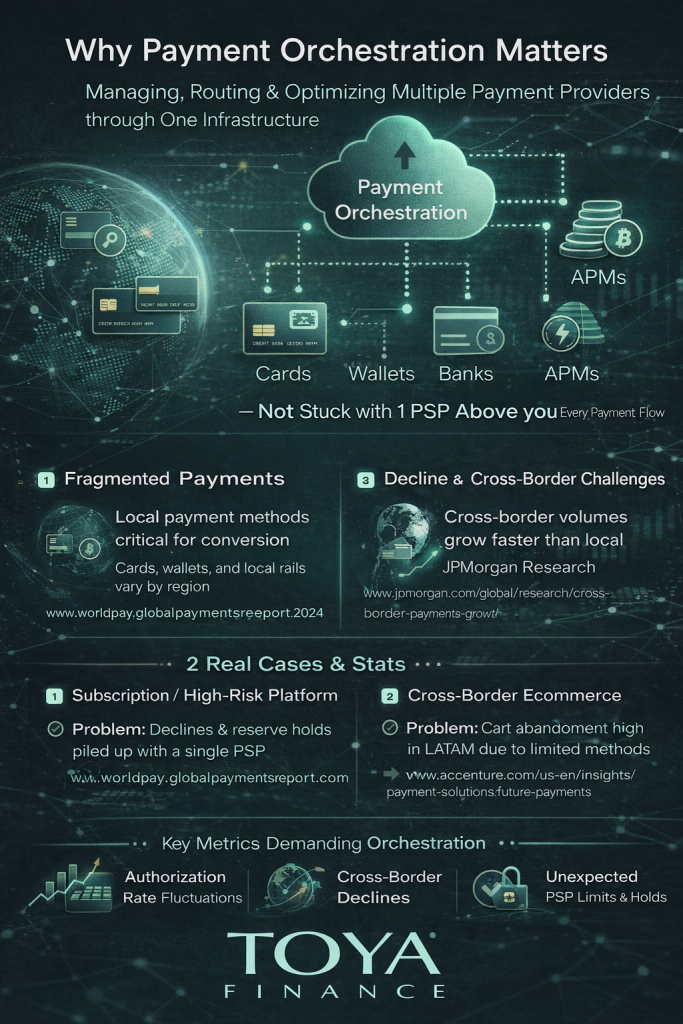
What Is Payment Orchestration?
Payment orchestration centralizes payment logic across multiple providers and methods. Instead of relying on a single PSP, merchants route transactions through a managed layer that intelligently selects:
- the best provider per transaction
- fallback routes for declines
- cost-optimized payment rails
- unified reconciliation and reporting
Without orchestration, merchants often encounter:
- inconsistent routing decisions
- fragmented reporting
- manual reconciliation
- lack of decline handling strategies
This limitation is well documented by industry research.
The Case for Orchestration — What Data Shows
1) Fragmentation of Global Payments
According to the Worldpay Global Payments Report 2024, payment preferences vary significantly by region. While cards dominate in North America and Europe, local digital wallets and bank redirects lead in Asia and LATAM.
“Local payment methods are critical to conversion in many markets, and a single-rail approach limits global reach.”
— Worldpay Global Payments Report 2024
🔗 https://worldpay.globalpaymentsreport.com/
This divergence implies that multiple rails must be managed centrally — not bolted on.
2) Declines & Cross-Border Challenges
A research note from JPMorgan’s Global Data highlights that cross-border payment volumes are growing faster than domestic ones, leading to greater reliance on multiple rails and partners to manage declines and settlement times.
🔗 https://www.jpmorgan.com/global/research/cross-border-payments-growth-2025
Key takeaway:
- cross-border complexity increases declines
- multi-rail strategies reduce friction
- orchestration enables dynamic choice of providers
3) Authorization & Routing Optimization
According to an Accenture Payments Report, merchants that implement analytics-driven routing see material improvements in authorization rates.
Merchants using automated routing and analytics can see up to 10-15% higher authorization rates compared to static routing.
— Accenture “Future of Payments” Report
🔗 https://www.accenture.com/us-en/insights/payment-solutions/future-payments
This highlights the value of data-driven orchestration rather than adding more PSPs manually.
Real Scenarios Where Orchestration Matters
Example 1 — Subscription / High-Risk Platform
Problem: A subscription platform lost revenue due to frequent declines and rolling reserves imposed by single PSP.
Orchestration Approach:
- Multiple PSP integrations
- Routing by geo performance
- Automated fallback paths
- Central visibility into declines
Result:
Authority declines fell, revenue leakage reduced, and cash flow became more predictable.
This problem and solution pattern aligns with real merchant cases documented by fintech publications:
🔗 “Subscription merchants are increasingly using smart routing to avoid single-provider risk,” — Finextra Insight
https://www.finextra.com/blogposting/25476/surviving-high-risk-payments-with-smart-routing
Example 2 — Cross-Border Ecommerce
Problem: An ecommerce brand saw higher abandonment rates in LATAM due to limited acceptance and high card fees.
Orchestration Approach:
- Real-time routing across PSPs
- Local wallets + bank redirects
- Fallback to alternative rails
Result:
Improved checkout completion and reduced cost per transaction.
This trend is echoed in this analysis:
🔗 “Cross-border ecommerce growth drives multi-rail payments adoption” — PaymentsJournal
https://www.paymentsjournal.com/cross-border-ecommerce-multi-rail-adoption/
Orchestration vs. Traditional Aggregators
Traditional PSP aggregators combine payment methods but often do not provide:
✔ vendor independence
✔ dynamic routing
✔ decline fallback logic
✔ central risk strategy
✔ unified analytics
Payment Orchestration Platforms do provide these, and this difference has been highlighted by Forrester and Gartner, noting the emergence of orchestration as a strategic layer:
🔗 Forrester: “The Rise of Payment Orchestration Platforms”
https://www.forrester.com/report/the-rise-of-payment-orchestration/
(subscription may be required)
Analytics & Risk Controls Are Core
Orchestration without analytics is blind.
Critical analytics features include:
- decline reason tracking
- cost vs. acceptance benchmarking
- currency and settlement performance
- provider thresholds and risk triggers
A McKinsey Report on Digital Payments emphasizes:
“Improving authorization, routing efficiency, and cross-rail performance requires strong data and real-time insights.”
🔗 https://www.mckinsey.com/industries/financial-services/our-insights/next-gen-payments
Key Takeaways
High-risk digital businesses must build payment stacks that:
- Diversify payment methods — cards, wallets, local rails, crypto
- Centralize orchestration logic — one layer controlling all rails
- Use data to drive routing & decline recovery
- Mitigate risk holistically — not per PSP
Payments are no longer a commodity. They are infrastructure — and orchestrated infrastructure delivers resilience, conversion, and revenue predictability.